Monday, 24 August 2015

August 2015 #GeriMedJC articles

This month we will be discussing two articles. In the live version of the Geriatric Medicine Journal Club held at the University of Toronto, the first 45 minutes of the hour is devoted to the presentation and discussion of the long article and the latter 15 minutes is reserved for presentation and appraisal of the short article.

Did you know that the live version of #GeriMedJC runs for an hour and is broadcast to several different hospitals in four different cities via the Ontario Telemedicine Network? 

Toronto: Mount Sinai Hospital, Sunnybrook Hospital, St. Michael’s Hospital, Baycrest Hospital, North York General Hospital, St. Joseph’s Hospital
Mississauga: Trillium Hospital
Kitchener-Waterloo: Grand River Hospital, St. Mary's Hospital
Orillia: Soldier's Memorial Hospital

Can't join us live? No worries!  Engage in the discussion on Twitter on August 28, 2015 at 08:00 EDT / 12:00 GMT and don't forget to use the hashtag #GeriMedJC.


The long article this month should provide an interesting discussion on study design and statistical methodology.  This study utilizes a delayed-start, also known as randomized-start, to demonstrate disease-modification drug effect.  We will take a look at this study of an investigational treatment for mild Alzheimer's disease:


Delayed-start analysis: Mild Alzheimer's disease patients in solanezumab trials, 3.5 years. Alzheimer's & Dementia: Translational Research & Clinical Interventions. In press. 2015. 

Access the article here or read the abstract below:

Introduction
Solanezumab is an anti-amyloid monoclonal antibody in clinical testing for treatment of Alzheimer's disease (AD). Its mechanism suggests the possibility of slowing the progression of AD.

Methods
A possible disease-modifying effect of solanezumab was assessed using a new statistical method including noninferiority testing. Performance differences were compared during the placebo-controlled period with performance differences after the placebo patients crossed over to solanezumab in the delayed-start period.

Results
Noninferiority of the 14-item Alzheimer's Disease Assessment Scale-Cognitive subscale (ADAS-Cog14) and Alzheimer's Disease Cooperative Study Activities of Daily Living inventory instrumental items (ADCS-iADL) differences was met through 132 weeks, indicating that treatment differences observed in the placebo-controlled period remained, within a predefined margin, after the placebo group initiated solanezumab. Solanezumab was well tolerated, and no new safety concerns were identified.

Discussion

The results of this secondary analysis show that the mild subgroup of solanezumab-treated patients who initiated treatment early, at the start of the placebo-controlled period, retained an advantage at most time points in the delayed-start period.


The short article discussion will follow the long article discussion.  The currently available live-attenuated vaccine against herpes zoster has two major limitations: diminishing efficacy against shingles with increasing age of vaccine recipients and contraindication for use in immunocompromised individuals.  Could recombinant subunit vaccines fill in this gap?  In this month's #GeriMedJC, the following trial will be appraised.


Efficacy of an adjuvanted herpes zoster subunit vaccine in older adults. N Engl J Med. 2015 May 28;372(22):2087-96. 

PMID: 25916341

Access the article here or read the abstract below:

BACKGROUND:
In previous phase 1-2 clinical trials involving older adults, a subunit vaccine containing varicella-zoster virus glycoprotein E and the AS01B adjuvant system (called HZ/su) had a clinically acceptable safety profile and elicited a robust immune response.

METHODS:
We conducted a randomized, placebo-controlled, phase 3 study in 18 countries to evaluate the efficacy and safety of HZ/su in older adults (≥50 years of age), stratified according to age group (50 to 59, 60 to 69, and ≥70 years). Participants received two intramuscular doses of the vaccine or placebo 2 months apart. The primary objective was to assess the efficacy of the vaccine, as compared with placebo, in reducing the risk of herpes zoster in older adults.

RESULTS:
A total of 15,411 participants who could be evaluated received either the vaccine (7698 participants) or placebo (7713 participants). During a mean follow-up of 3.2 years, herpes zoster was confirmed in 6 participants in the vaccine group and in 210 participants in the placebo group (incidence rate, 0.3 vs. 9.1 per 1000 person-years) in the modified vaccinated cohort. Overall vaccine efficacy against herpes zoster was 97.2% (95% confidence interval [CI], 93.7 to 99.0; P<0.001). Vaccine efficacy was between 96.6% and 97.9% for all age groups. Solicited reports of injection-site and systemic reactions within 7 days after vaccination were more frequent in the vaccine group. There were solicited or unsolicited reports of grade 3 symptoms in 17.0% of vaccine recipients and 3.2% of placebo recipients. The proportions of participants who had serious adverse events or potential immune-mediated diseases or who died were similar in the two groups.

CONCLUSIONS:
The HZ/su vaccine significantly reduced the risk of herpes zoster in adults who were 50 years of age or older. Vaccine efficacy in adults who were 70 years of age or older was similar to that in the other two age groups.

Saturday, 25 July 2015

Short article for July's #GeriMedJC

After a short hiatus in June, #GeriMedJC returns on July 31, 2015 at 08:00 EDT / noon GMT.

See the previous blog post for the long article which will precede the short article discussion.
What does a short article mean?  In the live version of the Geriatric Medicine Journal Club held at the University of Toronto, the last 15 minutes of the hour is devoted to the presentation and discussion of the article. The study chosen for the short article discussion is:


Ngandu T, Lehtisalo J, Solomon A, Levälahti E, Ahtiluoto S, Antikainen R, Bäckman L, Hänninen T, Jula A, Laatikainen T, Lindström J, Mangialasche F, Paajanen T, Pajala S, Peltonen M, Rauramaa R, Stigsdotter-Neely A, Strandberg T, Tuomilehto J, Soininen H, Kivipelto M. A 2 year multidomain intervention of diet, exercise, cognitive training, and vascular risk monitoring versus control to prevent cognitive decline in at-risk elderly people (FINGER): a randomised controlled trial. Lancet. 2015 Jun 6;385(9984):2255-63.

PMID: 25771249

Access the article here or read the abstract below:

BACKGROUND:
Modifiable vascular and lifestyle-related risk factors have been associated with dementia risk in observational studies. In the Finnish Geriatric Intervention Study to Prevent Cognitive Impairment and Disability (FINGER), a proof-of-concept randomised controlled trial, we aimed to assess a multidomain approach to prevent cognitive decline in at-risk elderly people from the general population.

METHODS:
In a double-blind randomised controlled trial we enrolled individuals aged 60-77 years recruited from previous national surveys. Inclusion criteria were CAIDE (Cardiovascular Risk Factors, Aging and Dementia) Dementia Risk Score of at least 6 points and cognition at mean level or slightly lower than expected for age. We randomly assigned participants in a 1:1 ratio to a 2 year multidomain intervention (diet, exercise, cognitive training, vascular risk monitoring), or a control group (general health advice). Computer-generated allocation was done in blocks of four (two individuals randomly allocated to each group) at each site. Group allocation was not actively disclosed to participants and outcome assessors were masked to group allocation. The primary outcome was change in cognition as measured through comprehensive neuropsychological test battery (NTB) Z score. Analysis was by modified intention to treat (all participants with at least one post-baseline observation). This trial is registered at ClinicalTrials.gov, number NCT01041989.

FINDINGS:
Between Sept 7, 2009, and Nov 24, 2011, we screened 2654 individuals and randomly assigned 1260 to the intervention group (n=631) or control group (n=629). 591 (94%) participants in the intervention group and 599 (95%) in the control group had at least one post-baseline assessment and were included in the modified intention-to-treat analysis. Estimated mean change in NTB total Z score at 2 years was 0·20 (SE 0·02, SD 0·51) in the intervention group and 0·16 (0·01, 0·51) in the control group. Between-group difference in the change of NTB total score per year was 0·022 (95% CI 0·002-0·042, p=0·030). 153 (12%) individuals dropped out overall. Adverse events occurred in 46 (7%) participants in the intervention group compared with six (1%) participants in the control group; the most common adverse event was musculoskeletal pain (32 [5%] individuals for intervention vs no individuals for control).

INTERPRETATION:

Findings from this large, long-term, randomised controlled trial suggest that a multidomain intervention could improve or maintain cognitive functioning in at-risk elderly people from the general population.

Did you know that the live version of #GeriMedJC runs for an hour and is broadcast to several different hospitals in four different cities via the Ontario Telemedicine Network? 

Toronto: Mount Sinai Hospital, Sunnybrook Hospital, St. Michael’s Hospital, Baycrest Hospital, North York General Hospital, St. Joseph’s Hospital
Mississauga: Trillium Hospital
Kitchener-Waterloo: Grand River Hospital, St. Mary's Hospital
Orillia: Soldier's Memorial Hospital

Can't join us live? No worries!  Engage in the discussion on Twitter on July 31, 2015 at 08:00 EDT / 12:00 GMT and don't forget to use the hashtag #GeriMedJC.

Sunday, 19 July 2015

#GeriMedJC is back for July!

After a short hiatus in June, #GeriMedJC returns on July 31, 2015 at 08:00 EDT / noon GMT.

What does a long article mean?  In the live version of the Geriatric Medicine Journal Club held at the University of Toronto, the first 45 minutes of the hour is devoted to the presentation and discussion of the article. The study chosen for the long article discussion is:


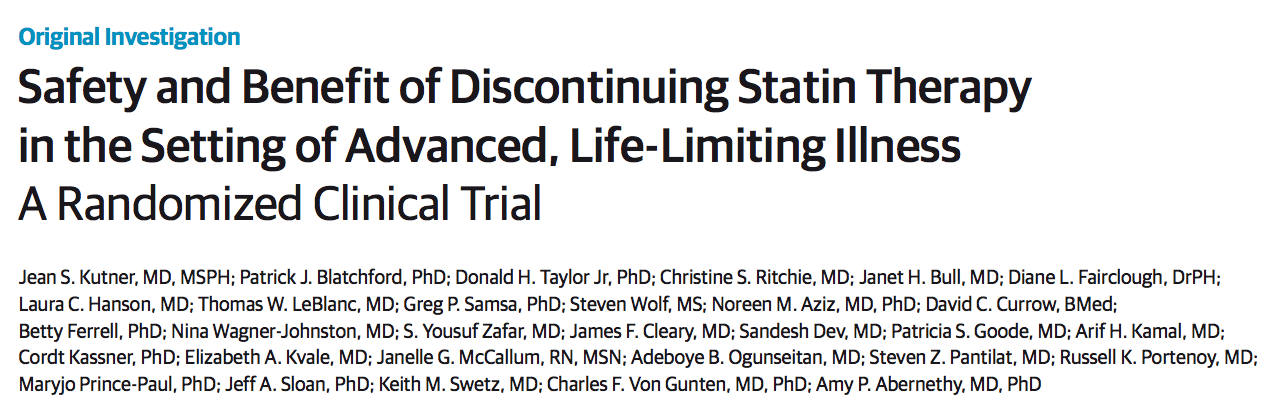
Kutner JS, Blatchford PJ, Taylor DH Jr, Ritchie CS, Bull JH, Fairclough DL, Hanson LC, LeBlanc TW, Samsa GP, Wolf S, Aziz NM, Currow DC, Ferrell B, Wagner-Johnston N, Zafar SY, Cleary JF, Dev S, Goode PS15, Kamal AH, Kassner C, Kvale EA, McCallum JG17, Ogunseitan AB, Pantilat SZ, Portenoy RK, Prince-Paul M, Sloan JA, Swetz KM23, Von Gunten CF, Abernethy AP. Safety and benefit of discontinuing statin therapy in the setting of advanced, life-limiting illness: a randomized clinical trial. JAMA Intern Med. 2015 May;175(5):691-700. 

This article is a great example of a trial which will inform evidence-based de-prescribing, a much needed area in an era of increasing numbers of clinical practice guidelines which concentrate usually on the opposite. 

Given the nature of the topic, we would like to extend a formal invitation to #hpm to weigh in on the discussion!
  
This article here and the abstract can be found below:

IMPORTANCE:
For patients with limited prognosis, some medication risks may outweigh the benefits, particularly when benefits take years to accrue; statins are one example. Data are lacking regarding the risks and benefits of discontinuing statin therapy for patients with limited life expectancy.

OBJECTIVE:
To evaluate the safety, clinical, and cost impact of discontinuing statin medications for patients in the palliative care setting.

DESIGN, SETTING, AND PARTICIPANTS:
This was a multicenter, parallel-group, unblinded, pragmatic clinical trial. Eligibility included adults with an estimated life expectancy of between 1 month and 1 year, statin therapy for 3 months or more for primary or secondary prevention of cardiovascular disease, recent deterioration in functional status, and no recent active cardiovascular disease. Participants were randomized to either discontinue or continue statin therapy and were monitored monthly for up to 1 year. The study was conducted from June 3, 2011, to May 2, 2013. All analyses were performed using an intent-to-treat approach.

INTERVENTIONS:
Statin therapy was withdrawn from eligible patients who were randomized to the discontinuation group. Patients in the continuation group continued to receive statins.

MAIN OUTCOMES AND MEASURES:
Outcomes included death within 60 days (primary outcome), survival, cardiovascular events, performance status, quality of life (QOL), symptoms, number of nonstatin medications, and cost savings.

RESULTS:
A total of 381 patients were enrolled; 189 of these were randomized to discontinue statins, and 192 were randomized to continue therapy. Mean (SD) age was 74.1 (11.6) years, 22.0% of the participants were cognitively impaired, and 48.8% had cancer. The proportion of participants in the discontinuation vs continuation groups who died within 60 days was not significantly different (23.8% vs 20.3%; 90% CI, -3.5% to 10.5%; P=.36) and did not meet the noninferiority end point. Total QOL was better for the group discontinuing statin therapy (mean McGill QOL score, 7.11 vs 6.85; P=.04). Few participants experienced cardiovascular events (13 in the discontinuation group vs 11 in the continuation group). Mean cost savings were $3.37 per day and $716 per patient.

CONCLUSIONS AND RELEVANCE:
This pragmatic trial suggests that stopping statin medication therapy is safe and may be associated with benefits including improved QOL, use of fewer nonstatin medications, and a corresponding reduction in medication costs. Thoughtful patient-provider discussions regarding the uncertain benefit and potential decrement in QOL associated with statin continuation in this setting are warranted.

Did you know that the live version of #GeriMedJC runs for an hour and is broadcast to several different hospitals in four different cities via the Ontario Telemedicine Network? 

Toronto: Mount Sinai Hospital, Sunnybrook Hospital, St. Michael’s Hospital, Baycrest Hospital, North York General Hospital, St. Joseph’s Hospital
Mississauga: Trillium Hospital
Kitchener-Waterloo: Grand River Hospital, St. Mary's Hospital
Orillia: Soldier's Memorial Hospital

Can't join us live? No worries!  Engage in the discussion on Twitter on July 31, 2015 at 08:00 EDT / 12:00 GMT and don't forget to use the hashtag #GeriMedJC.


Saturday, 30 May 2015

May 2015 #GeriMedJC

The two articles critically appraised and discussed during the May 2015 #GeriMedJC were:

Carpenter CR, Shelton E, Fowler S, Suffoletto B, Platts-Mills TF, Rothman RE, Hogan TM. Risk factors and screening instruments to predict adverse outcomes for undifferentiated older emergency department patients: a systematic review and meta-analysis. Acad Emerg Med. 2015 Jan;22(1):1-21. 

Black DS, O'Reilly GA, Olmstead R, Breen EC, Irwin MR. Mindfulness meditation and improvement in sleep quality and daytime impairment among older adults with sleep disturbances: a randomized clinical trial. JAMA Intern Med. 2015 Apr 1;175(4):494-501.

It was great having our emergency medicine colleagues (such as @geri_em, @GeriatricEDNews) contribute to the long article discussion. It seems like there's lots of opportunity for research in the area of risk stratification in elderly emergency department patients.  Thanks for making this the largest #GeriMedJC to date:
Missed the discussion?  You can get the transcript of the #GeriMedJC tweet chat here.

Thanks again to all those who participated in the Tweet chat:


You may also view articles discussed at prior #GeriMedJC tweetchats at PubMed Commons. (linkWe'll be taking a break from #GeriMedJC in June and will return in July. Stay tuned for the date and articles!  Tweet you then!

Thursday, 21 May 2015

#GeriMedJC welcomes #PsychJC for short article tweet chat on May 29

What does the short article mean?  In the live version of the Geriatric Medicine Journal Club held at the University of Toronto, the last 15 minutes of the hour is devoted to the presentation and discussion of the article. The short article for the May 29 #GeriMedJC discussion is:
Who doesn't want more sleep?  Older adults are no exemption.  We will be reviewing this study which examines the efficacy of a mind-body medicine intervention, called mindfulness meditation, to promote sleep quality in older adults with moderate sleep disturbances.


Given the nature of the topic, we would like to extend a formal invitation to #PsychJC to weigh in on the discussion!  This article can be found here.  The abstract can be found below.

Black DS, O'Reilly GA, Olmstead R, Breen EC, Irwin MR. Mindfulness meditation and improvement in sleep quality and daytime impairment among older adults with sleep disturbances: a randomized clinical trial. JAMA Intern Med. 2015 Apr 1;175(4):494-501.

IMPORTANCE: Sleep disturbances are most prevalent among older adults and often go untreated. Treatment options for sleep disturbances remain limited, and there is a need for community-accessible programs that can improve sleep.

OBJECTIVE: To determine the efficacy of a mind-body medicine intervention, called mindfulness meditation, to promote sleep quality in older adults with moderate sleep disturbances.

DESIGN, SETTING, AND PARTICIPANTS: Randomized clinical trial with 2 parallel groups conducted from January 1 to December 31, 2012, at a medical research center among an older adult sample (mean [SD] age, 66.3 [7.4] years) with moderate sleep disturbances (Pittsburgh Sleep Quality Index [PSQI] >5).

INTERVENTIONS: A standardized mindful awareness practices (MAPs) intervention (n = 24) or a sleep hygiene education (SHE) intervention (n = 25) was randomized to participants, who received a 6-week intervention (2 hours per week) with assigned homework.

MAIN OUTCOMES AND MEASURES: The study was powered to detect between-group differences in moderate sleep disturbance measured via the PSQI at postintervention. Secondary outcomes pertained to sleep-related daytime impairment and included validated measures of insomnia symptoms, depression, anxiety, stress, and fatigue, as well as inflammatory signaling via nuclear factor (NF)-κB.

RESULTS: Using an intent-to-treat analysis, participants in the MAPs group showed significant improvement relative to those in the SHE group on the PSQI. With the MAPs intervention, the mean (SD) PSQIs were 10.2 (1.7) at baseline and 7.4 (1.9) at postintervention. With the SHE intervention, the mean (SD) PSQIs were 10.2 (1.8) at baseline and 9.1 (2.0) at postintervention. The between-group mean difference was 1.8 (95% CI, 0.6-2.9), with an effect size of 0.89. The MAPs group showed significant improvement relative to the SHE group on secondary health outcomes of insomnia symptoms, depression symptoms, fatigue interference, and fatigue severity (P < .05 for all). Between-group differences were not observed for anxiety, stress, or NF-κB, although NF-κB concentrations significantly declined over time in both groups (P < .05).

CONCLUSIONS AND RELEVANCE: The use of a community-accessible MAPs intervention resulted in improvements in sleep quality at immediate postintervention, which was superior to a highly structured SHE intervention. Formalized mindfulness-based interventions have clinical importance by possibly serving to remediate sleep problems among older adults in the short term, and this effect appears to carry over into reducing sleep-related daytime impairment that has implications for quality of life.

Did you know that the live version of #GeriMedJC runs for an hour and is broadcast to nine different hospitals in four different cities via the Ontario Telemedicine Network?  Can't join us live? No worries!  Engage in the discussion on Twitter on May 29, 2015 at 08:00 EDT / 12:00 GMT and don't forget to use the hashtag #GeriMedJC.

#GeriMedJC welcomes #ALiEMJC for long article tweet chat on May 29

What does a long article mean?  In the live version of the Geriatric Medicine Journal Club held at the University of Toronto, the first 45 minutes of the hour is devoted to the presentation and discussion of the article. The long article for the May 29 #GeriMedJC discussion is:


Providing high-quality emergency care for older adults is challenging because older patients tend to have more co-morbidities, higher rates of serious illnesses, and frequent communication barriers.  Use of screening instruments may allow identification of geriatric patients who are at increased risk for readmission or other adverse outcomes; the results of the screening could potentially be then used to guide targeted interventions.

Given the nature of the topic, we would like to extend a formal invitation to Academic Life in Emergency Medicine (ALiEM) Journal Club (#ALiEMJC) to weigh in on the discussion!
  
This article is open access and can be found here.  The abstract can be found below.

Carpenter CR, Shelton E, Fowler S, Suffoletto B, Platts-Mills TF, Rothman RE, Hogan TM. Risk factors and screening instruments to predict adverse outcomes for undifferentiated older emergency department patients: a systematic review and meta-analysis. Acad Emerg Med. 2015 Jan;22(1):1-21. 

OBJECTIVES:
A significant proportion of geriatric patients experience suboptimal outcomes following episodes of emergency department (ED) care. Risk stratification screening instruments exist to distinguish vulnerable subsets, but their prognostic accuracy varies. This systematic review quantifies the prognostic accuracy of individual risk factors and ED-validated screening instruments to distinguish patients more or less likely to experience short-term adverse outcomes like unanticipated ED returns, hospital readmissions, functional decline, or death.

METHODS:
A medical librarian and two emergency physicians conducted a medical literature search of PubMed, EMBASE, SCOPUS, CENTRAL, and ClinicalTrials.gov using numerous combinations of search terms, including emergency medical services, risk stratification, geriatric, and multiple related MeSH terms in hundreds of combinations. Two authors hand-searched relevant specialty society research abstracts. Two physicians independently reviewed all abstracts and used the revised Quality Assessment of Diagnostic Accuracy Studies instrument to assess individual study quality. When two or more qualitatively similar studies were identified, meta-analysis was conducted using Meta-DiSc software. Primary outcomes were sensitivity, specificity, positive likelihood ratio (LR+), and negative likelihood ratio (LR-) for predictors of adverse outcomes at 1 to 12 months after the ED encounters. A hypothetical test-treatment threshold analysis was constructed based on the meta-analytic summary estimate of prognostic accuracy for one outcome.

RESULTS:
A total of 7,940 unique citations were identified yielding 34 studies for inclusion in this systematic review. Studies were significantly heterogeneous in terms of country, outcomes assessed, and the timing of post-ED outcome assessments. All studies occurred in ED settings and none used published clinical decision rule derivation methodology. Individual risk factors assessed included dementia, delirium, age, dependency, malnutrition, pressure sore risk, and self-rated health. None of these risk factors significantly increased the risk of adverse outcome (LR+ range = 0.78 to 2.84). The absence of dependency reduces the risk of 1-year mortality (LR- = 0.27) and nursing home placement (LR- = 0.27). Five constructs of frailty were evaluated, but none increased or decreased the risk of adverse outcome. Three instruments were evaluated in the meta-analysis: Identification of Seniors at Risk, Triage Risk Screening Tool, and Variables Indicative of Placement Risk. None of these instruments significantly increased (LR+ range for various outcomes = 0.98 to 1.40) or decreased (LR- range = 0.53 to 1.11) the risk of adverse outcomes. The test threshold for 3-month functional decline based on the most accurate instrument was 42%, and the treatment threshold was 61%.

CONCLUSIONS:
Risk stratification of geriatric adults following ED care is limited by the lack of pragmatic, accurate, and reliable instruments. Although absence of dependency reduces the risk of 1-year mortality, no individual risk factor, frailty construct, or risk assessment instrument accurately predicts risk of adverse outcomes in older ED patients. Existing instruments designed to risk stratify older ED patients do not accurately distinguish high- or low-risk subsets. Clinicians, educators, and policy-makers should not use these instruments as valid predictors of post-ED adverse outcomes. Future research to derive and validate feasible ED instruments to distinguish vulnerable elders should employ published decision instrument methods and examine the contributions of alternative variables, such as health literacy and dementia, which often remain clinically occult.

Did you know that the live version of #GeriMedJC runs for an hour and is broadcast to nine different hospitals in four different cities via the Ontario Telemedicine Network?  
  • Toronto: Mount Sinai Hospital, Sunnybrook Hospital, St. Michael’s Hospital, Baycrest Hospital, North York General Hospital, St. Joseph’s Hospital
  • Mississauga: Trillium Hospital
  • Kitchener-Waterloo: Grand River Hospital
  • Orillia: Soldier's Memorial Hospital

Can't join us live? No worries!  Engage in the discussion on Twitter on May 29, 2015 at 08:00 EDT / 12:00 GMT and don't forget to use the hashtag #GeriMedJC.


Thank you to our over 400 @GeriMedJC followers!

Here's a shout out to the 400 @GeriMedJC followers!  Thanks for making the #GeriMedJC an international discussion!